
Capt Gideon Osen

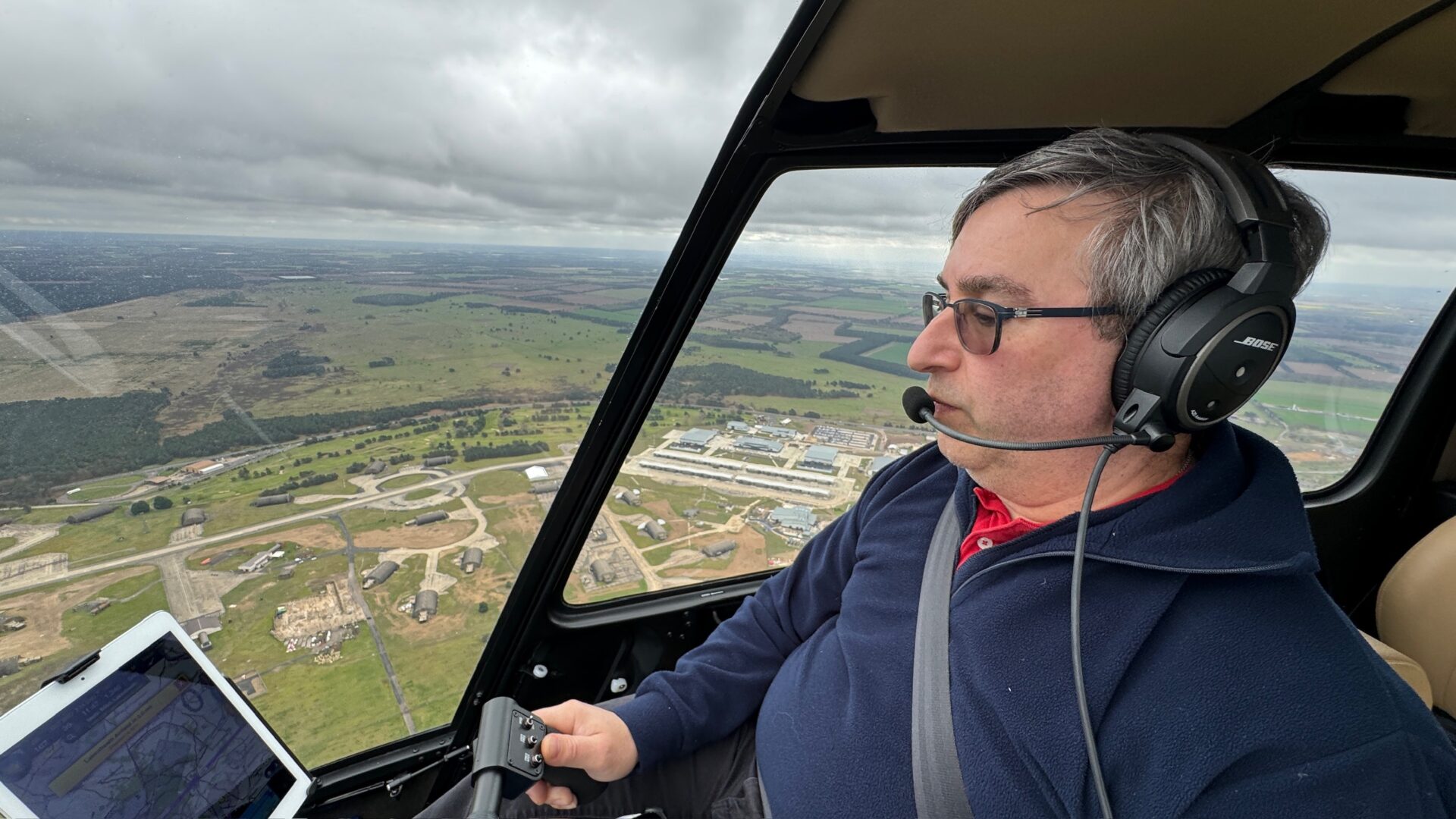
“Many years ago I gained my fixed wing PPL but stopped flying because my family weren’t interested and there were very few places to go especially VFR. I had the obligatory fish and chips on the Isle of Wight, took various friends for cups of tea at sundry airfields and went to Le Touquet but after that it seemed a little pointless.
Fast forward 16 years and my wife made the silly mistake of buying me a helicopter lesson for my birthday. I had always hankered for a helicopter licence but the time, complexity and cost had always put me off.
My first lesson was fun – a Cabri but I really didn’t like the way the ‘rudder’ or tail rotor worked so I tried an R22 and that just felt more comfortable
At this point I started looking at my options. As the holder of a (lapsed) fixed wing licence I could technically avoid some of the exams but eventually it transpired that in order to avail myself of this I needed my fixed wing licence to be current which would involve taking fixed wing lessons to get back in the saddle. I decided it was easier to just retake the exams because frankly none of them were particularly onerous in my recollection
I also needed to renew my FRTOL (Flight Radio Telephony Operators Licence). A simple task made complex by the CAA who had decided in their infinite wisdom that as a result of transitioning between one set of rules with impenetrable acronyms to another in the 16 years that had elapsed from my last flight, my proficiency in English was deemed to be level 5 and not the required level 6. I therefore had to spend £30 to get a signature on a piece of paper from an examiner to prove that my native English was sufficient. I sent this to the CAA who very efficiently sent me a new licence completely missing the required FRTOL. A further letter to them pointing out their inability to do the one thing I had asked them to do fixed this and thus armed I was set to go.
Learning to fly a helicopter is not easy especially for me as I had not spent my formative years playing video games. Harder in almost every respect than fixed wing aircraft. Helicopters are technically and aerodynamically far more complex. They are also inherently unstable and thus require constant attention and control input whereas a fixed wing craft is stable and doesn’t fall out of the sky if you take your hands off the controls. In my opinion landing is easier in a helicopter but in every other respect helicopters require a greater level of skill and understanding.
There is a correlation between age and the length of time it takes to get a licence. Being in my mid 50’s it was always going to be a long process. Fortunately, having made the mistake on my fixed wing training of obsessing about milestones such as flying solo, I actively decided not to have any expectations on time or milestones and had no desire to progress to the next level until I and my instructors had decided I was good and ready.
I made rapid initial progress but then inexplicably got worse. Paul suggested I switch to the R44 which is heavier and less twitchy and also has the advantage that it could take passengers when my licence eventually materialised.
I had a number of instructors over the next few months which suited me since each one brought a new perspective. However as I approached the time when I was ready to go solo this lack of consistency was detrimental. I was “signed off” by one instructor and set off with Paul to prove to him I was ready to fly solo. What ensued almost made me give up flying altogether. Paul took me out for a check ride in which everything that could be done wrong was done wrong. It was clear that the standard that Paul expected was very different to the other instructors!
A decent period of introspection followed during which I took a good hard look at myself. I considered giving it all up as a bad job but eventually decided that it was actually in my interests to have a hard task master and that I would ultimately become a better pilot as a result.
My mistake was not taking the theoretical side of things seriously. I have always been good at studying and had sailed through a number of exams but I hadn’t really understood in depth what was happening and what is required especially in emergency situations. Reviewing and talking through the various scenarios and watching videos on the net (Pilot Yellow is extremely good) really helped.
After quite a lot of practice and retraining I was eventually ready for my first solo. Paul was like a mother hen, busy clucking around and telling me over and over again about the dangers of flying solo for the first time without the weight of the instructor to balance my rotund form. Dynamic rollover was mentioned every 20 seconds or so in the hour leading up to my solo and when it eventually came the actual lift off was a complete non event although a momentous moment for me.
One thing I would highly recommend for those learning in a 4+ seater is to fly with passengers. I did this mainly to remind myself why I was putting myself through this torture in the first place but actually the experience was very valuable. We had a couple of trips to Jimmy’s Farm, Cromer and the Pig at Bath which really helped. In my opinion this should be a requirement of training because with the R44 two up there really is no danger of running out of power except in very extreme situations and no chance of operating at the margins of the CofG envelope. Adding a couple of hundred pounds of human being really changes the feel of the helicopter and teaches you more than any book that you have to take care when fully laden.
I decided to blitz the cross country section so came in for lessons every day for a week and by the Friday I had my qualifying cross country done and dusted. Along the way I had uttered the immortal words when approaching Duxford “Visual with the Spitfire”. An amazing sight I have to tell you!
I then finished off all my remaining exams so all that was left was the final test.
At this point it should have been plain sailing but I managed to go backwards quite successfully. It seemed that I couldn’t navigate my way out of a paper bag. I could do the maths and planning easily enough but get me in the air and I totally blew it. This was a shock to me because after all I had got my fixed wing licence in the days before sat navs and should, in theory, have been fine but finding a building or a disused airfield often proved beyond my capabilities.
More and intensive practice and better planning using Google Earth really helped and eventually I had improved to the point where I was at a sufficient standard for the test
I had what seemed to be endless mock skills tests where my ability to withstand stress was tested and found wanting. More and more practice followed to the point where I was convinced I wouldn’t ever make it. However the practice started to pay off. It got to the point where I could autorotate without thinking about it, could deal with an emergency almost before it had happened and could land on a sixpence. Navigation was still my achilles heel but I got the nod from Paul and I was good to go.
The day before the test was nerve wracking. Would the weather hold? Would I sleep? What if I was awful? What if I couldn’t remember the settings for the advanced autos? However, the day of the test arrived, the weather was checked and all looked ok..
Tamzin the examiner was very correct. She read the standards document to me and answered all my questions. I was given the navigation route and was relieved to see it was familiar territory but the last part of the nav before I could switch on the sat nav and relax was to a place I had only seen once before. I went to my office just down the road from the airfield to prepare because I needed peace, quiet and a decent computer. I went over and over the route in my head and then headed for the airfield. At the helicopter Tamzin managed to find the one bit of the helicopter I couldn’t immediately identify when testing my knowledge ( FYI the manifold pressure gauge pipe adjacent to the oil filler which I figured out by a process of elimination) which filled me with dread that I had failed before I had begun. In the cockpit I deliberately slowed myself down to calm my nerves and managed to get the engine started and everything ready to go without mishap.
After leaving the ATC I called Farnborough who confused the hell out of me by telling me I had the wrong pressure setting only to then tell me the pressure setting was what I had initially said. The Nav went smoothly until the 1:250,000 track crawl where in the words of Tamzin “ I almost snatched defeat from the jaws of victory”. However disaster was averted; I found the target and it was game on. The rest of the test was reasonably straightforward and the hours of repetition came into their own. Returning to the airfield about 3 miles out, Tamzin switched off the hydraulics and my only reaction was “did you have to do it so far out!”. I felt really good and at no point was I concerned I couldn’t handle the aircraft. Back at the airfield, I went through all the fun stuff, quickstops, landing into and out of wind, sloping ground etc and we then headed to the pad where having shut down the aircraft Tamzin told me I had passed.
All in all it took me over 150 hours and three years to pass the test and of that the Covid lockdown probably accounted for at least a year. In that time many students had started and finished in a fraction of the time I had taken but frankly I didn’t and I don’t care. I have my licence and now I have it, it doesn’t matter how long it took me to get it.
Would I do it all again?. Probably, because the academic rigour required has kept me amused for quite some time and there is a real sense of achievement.
Would I recommend Flying Pig & Elstree Helicopters? Yes I would. They are professional, friendly and provide a good service. That said some other questions occur to me
- Is Paul a sticker for rules and procedures? Most certainly.
- Is that irritating sometimes? Absolutely but frankly helicopters can be dangerous and having someone who takes the job seriously is important
- Do I feel that I have been well trained? Definitely
So what does the rotary future hold for me. Well I want to do some trips on my own. Having a helicopter is apparently more cool than a plane so my family have deigned to accompany me. My basic plan is to enjoy the freedom of being able to go where I want and land wherever I fancy – almost.”
– Capt. Gideon Osen